Bluebells in Tarvin Woodlands – English or Spanish?


Tarvin woodland’s bluebells
Fifty years ago, our woodland was farmers’ fields. The wildflowers that grew were the wildflowers native to our bit of the Cheshire countryside. Thus, anything that now grows in the woodland in any amount has either been in the soil’s seed bank from that time, has been brought in by wind, animals or birds or has been planted by humans.
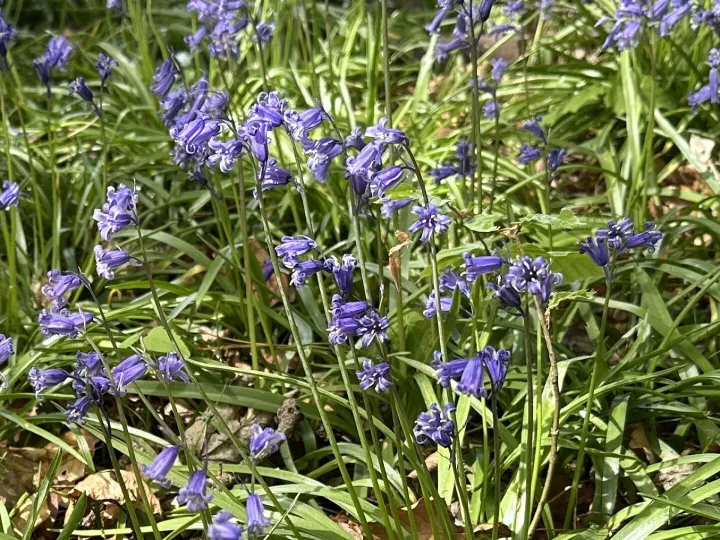
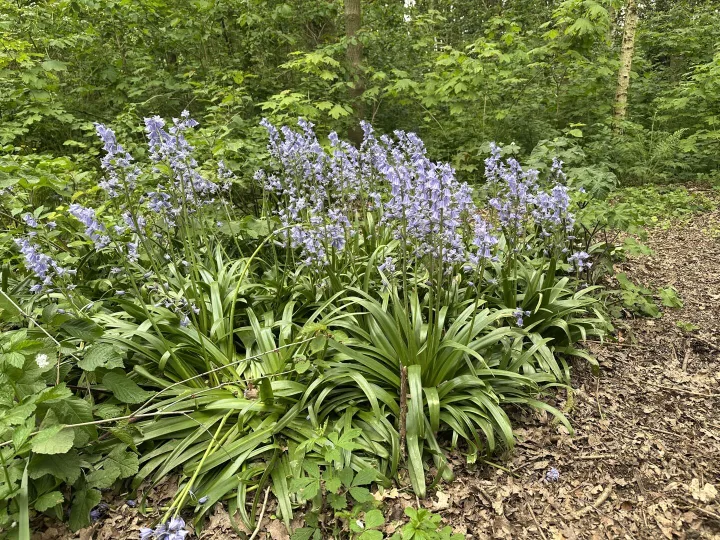
We are fortunate that our woodland, in May, has had a proliferation of bluebells, principally in the densely wooded part to the right of the Hockenhull Lane gateways, but spreading in small patches throughout the woodland. Bluebells are woodland flowers and, since the former farmers’ fields were grassland, these bluebells are unlikely to have come from the seedbank in the soil. There is another clue – one that involves a bit of the classification science around bluebells. The British bluebell is Hyacinthoides non-scripta. It is very fragrant, deep violet-blue with cream-coloured pollen, and has narrow leaves, with drooping stems and the bells all on one side of the flower stem. However, an imported bluebell has found favour in our gardens as a garden bluebell, because it is more vigorous and is tolerant of sunlight. This is the Spanish bluebell, Hyacinthoides Hispanica – it has more upright stems, broader leaves, and its flowers have green or blue pollen, are unscented, and paler, being placed all around the flower stem. First imported by the Victorians for their gardens, Spanish bluebells are now to be found all across the country. It is these that are to be seen near Hockenhull Lane.
When the Trust was first established, it was Jim Grogan’s ambition to have an all-native woodland. To this end, he proposed to remove ALL of the Spanish bluebells in our woodland and replace them with English bluebells. However, when he took advice on this, he was told that the two species would cross-pollinate and thus hybridise (crossbreed) very readily. Tarvin village gardens are FULL of Spanish bluebells, and the bees and other insects would certainly transfer the pollen. Thus, planting English bluebells was considered futile, and the project was abandoned, with the glorious display of the Spanish bluebells (which, no doubt, had originally been planted by villagers in the early days) providing great enjoyment instead.
Tarvin Community Woodland Trust has the benefit of a botanical advisor, Dr Jane Roberts. She has been helping us for many years, but her recent visit was the first time she had been while the bluebells were in flower. She was full of admiration for the display of bluebells and agreed that we had done just the right thing by following the advice and leaving well alone. She also gave us an easy way to identify the Spanish bluebell – the open bell flower is just right to make a hat for a tiny pixie! Not very scientific – but very effective!
However, in her walk-through, Jane found several English bluebells in a variety of places. What great good fortune! But, how did they get there? Certainly not from the original soil seed bank. We also think it highly unlikely that someone has deliberately planted them. We confess to being puzzled. Nonetheless, they are there, and we will watch with interest to see if they spread year by year. Here is yet another way in which our lovely woodland has surprised us! It really is worth taking a walk and keeping your eyes open. Who knows what you will find?
But please DO let us know when you find it!
Ed: There have been more British bluebells flowering in Delamerre forest this year, perhaps the conditions suit them this year?
Quick Links
Get In Touch
TarvinOnline is powered by our active community.
Please send us your news and views.